Cold Water, All Year
The springs
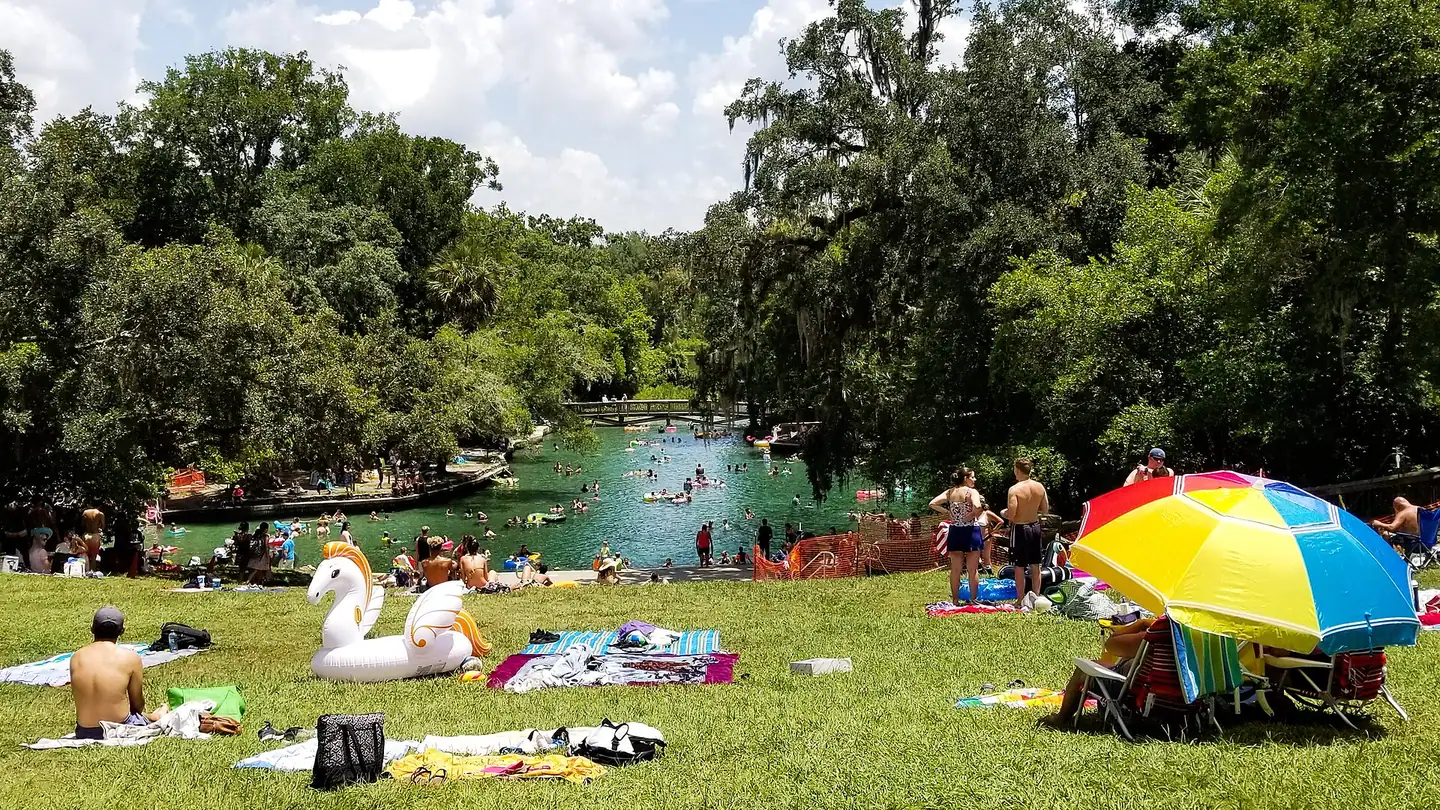
One piece of physics explains almost all of it: spring water holds about 72 degrees year round, and manatees need water warmer than about 68 degrees to survive the winter. That is why the same spring is a swim in July and a manatee refuge in January, and why some spring runs close to swimmers when the manatees move in.
Start close
Apopka
The closest true spring to downtown Orlando, about 25 to 35 minutes out: some 7,000 acres at the head of the Wekiva River. Swimming and snorkeling stay in the spring basin; the river beyond it is for paddling, with rentals at the park concession, and trails run from under a mile to about 13.5 miles. Manatees visit the river now and then in winter, but this is not a manatee refuge, and this page will not sell it as one.
Apopka
An Orange County park built around Rock Springs, about 30 to 40 minutes out, and the region's natural lazy river: a spring run of about half to three quarters of a mile that carries you on a tube in roughly 15 to 30 minutes, in water near 72 degrees. The park is famous for filling early; the gates close when it reaches capacity, which happens fast on warm weekends.
Blue Spring State Park
A first magnitude spring on the St. Johns River at Orange City, about 45 to 55 minutes out, and the best known winter manatee refuge in the region. From mid-November through March the spring run closes to swimming and all water activities so wintering manatees can rest undisturbed, and the visit becomes boardwalk viewing over clear water, with manatees often in the hundreds on cold days. In the warm months the run reopens for swimming, snorkeling and paddling.
De Leon Springs State Park
About an hour to an hour and ten minutes north: a 625 acre park around a spring that pushes some 19 to 20 million gallons a day into a swimming area about 30 feet deep over the boil, at about 72 degrees. The Old Spanish Sugar Mill, where guests cook their own pancakes at the table, has operated since 1961, and the park's Old Methuselah cypress is estimated at 500 to 600 years old. Paddle Spring Garden Creek out toward Lake Woodruff; winter manatees visit the creek, occasionally rather than on schedule.
The guide lists one way onto Blue Spring's water: Blue Spring Manatee Kayak Tours, a paddle outfitter based at the park. The park itself is written up here from Florida State Parks sources.
The Ocala forest springs
Three recreation areas in the Ocala National Forest, each holding about 72 degrees, each a different kind of day.
Alexander Springs
The friendliest of the forest springs for families and first timers: a first magnitude spring with a wide, gently sloping natural swimming basin, about an hour and 10 minutes to an hour and 20 minutes out. Swim, snorkel, or paddle the Alexander Creek run; there is a campground on site. Manatees are rare here; this is a swim and paddle day.
Juniper Springs
One of the oldest recreation areas in the forest, built in the 1930s by the Civilian Conservation Corps, with a stone walled spring pool and a historic millhouse, about an hour and 20 minutes to an hour and 30 minutes out. The swim is gentle. The adventure is Juniper Run, a 7 mile canoe and kayak run rated among the best in the country: narrow, winding and technical, not for beginners, and closed to paddleboards and inflatables.
Salt Springs
A mineral spring on the forest's north side, slightly warmer than most at about 72 to 74 degrees, and different in the water because of the minerals. A broad swim area, a boat launch onto Salt Springs Run and out to Lake George, and one of the largest campgrounds in the forest. About an hour and a half to an hour and 45 minutes out.
The river springs, west and north
The long drives. Each of these is a full day, and the page treats them that way.
Silver Springs State Park
A first magnitude spring group near Ocala, and Florida's first tourist attraction, famous for glass bottom boats since the 1870s; about an hour and 20 minutes to an hour and a half out. Know before you go: there is no swimming, wading, snorkeling or fishing anywhere in the park or on the Silver River. The day is the boats, a paddle down the river, and the hiking trails. Manatees are regulars on the river, watched from boats and paddle craft, and wild rhesus macaques live along the banks, released in the 1930s and best given a wide berth.
Rainbow Springs and the Rainbow River
The headsprings of the Rainbow River at Dunnellon, one of the largest spring groups in Florida by flow, about an hour and a half to an hour and 45 minutes out. The headsprings swim area runs 10 to 18 feet deep over white sand and limestone. Tubing does not happen at the headsprings: it uses a separate park entrance and floats about two hours, in season only, daily from Memorial Day to Labor Day and on weekends in April, May and September, and disposable containers are prohibited on the river. Below the park the river itself runs five to six clear miles to the Withlacoochee, and the common paddle, from KP Hole County Park, is a different trip from the headsprings swim.
Ichetucknee Springs State Park
Eight or more springs feeding a six mile river that is clear end to end; the headspring is a National Natural Landmark. In summer this is Florida's defining tube float: tubing season runs from the Saturday before Memorial Day through Labor Day, the North Entrance is capped at 750 tubers a day, and no food, drink or disposable items go on the river. Snorkelers head for Blue Hole Spring; scuba is allowed October to March, in Blue Hole only, and only for cave certified divers. The drive is two hours 15 minutes to two hours 30 minutes. A full day trip, not a quick add on.
The Gulf side: manatee country
Three Sisters Springs and Crystal River
The winter manatee capital, about an hour and 45 minutes to two hours west. Three Sisters Springs sits inside the Crystal River National Wildlife Refuge: 57 acres with boardwalk viewing and over two miles of trails. Manatee season runs November 15 to March 31, with warm water sanctuaries in effect; paddle craft are not allowed inside Three Sisters in season and return April 1 to November 14, and there is no swimming from the land side, swimmers arrive by water. Crystal River is the only place in the United States where swimming with wild manatees is legally permitted, under federal passive observation rules: look, do not touch, never enter a posted sanctuary. Peak density is mid-January to mid-February; a smaller resident group stays year round.
Weeki Wachee Springs State Park
The mermaid spring at Spring Hill, about an hour and 45 minutes to two hours out. Live mermaid shows have run since 1947 in a submerged theater seating about 400, Buccaneer Bay inside the park is a spring fed water park with slides and a swim area, and there is a riverboat cruise and paddling on the Weeki Wachee River, one of the clearest short spring runs in the state. Manatees turn up on the river, especially in the cooler months.
The private two
Privately owned, and a different product from the state parks: private rules, private land, and a livelier summer weekend scene at one of them. Labeled plainly, as they should be.
Ginnie Springs (private)
A privately owned park on the Santa Fe River near High Springs: over 200 acres with seven springs at about 72 degrees for swimming, snorkeling, tubing, paddling and camping. Divers come for the Ginnie Ballroom and the Devil's Spring System, open only to certified divers. There are no lifeguards, and pets are not allowed. The drive is two hours 15 minutes to two hours 30 minutes, and the summer weekend scene here is livelier than any state park on this page.
Devil's Den Prehistoric Spring (private)
A privately owned underground spring inside a dry cave at Williston, reached through a karst window in the cave roof, about an hour and 45 minutes to two hours out. The water holds about 72 degrees, the pool is about 120 feet across, and the maximum depth is about 54 feet. This is snorkel and scuba only; there is no general swimming, and entry runs on reservations with timed slots. Pleistocene fossils, including saber toothed cats and mastodons, were found here, which earns the prehistoric label, and on cold mornings steam rises from the opening, which is how it got its name.
In Season
Signature moments
Florida nature runs on seasons, not schedules. These are the moments worth planning a month around.
Water that glows
On the Space Coast lagoons, summer belongs to the dinoflagellates: microscopic plankton that flash blue green when the water is disturbed, roughly June through October, strongest in July and August, so every paddle stroke and passing fish leaves a lit trail. Winter has its own, stranger version: bioluminescent comb jellies, from late November to April and best in January and February, individual glowing animals you can see and gently hold; despite the name, they do not sting. Brightness depends on moon phase, water temperature and recent weather, the dark nights near a new moon are best, and no operator can guarantee a strong bloom. About 55 minutes to an hour and 10 minutes to the Merritt Island and Titusville launches.
Manatee season
The rule is a temperature: manatees depend on water warmer than about 68 degrees to survive winter, so as rivers and coastal water cool in the fall they travel to springs and other warm water sites, and they disperse again in spring. The honest season near Orlando is mid-November through March, densest in the coldest weeks, playing out at Blue Spring's boardwalks and at Three Sisters Springs in Crystal River. A resident handful of manatees can be found at Crystal River year round, and Haulover Canal at Merritt Island has a manatee observation deck. Disturbing manatees at a warm water site can push them out into cold water that can kill them, which is why the etiquette in the last section is not decorative. On the water: go slow in posted manatee zones, wear polarized glasses to spot them, watch for the circular footprints a submerged manatee leaves on the surface, and report an injured, distressed or dead manatee to the FWC Wildlife Alert Hotline at 888-404-FWCC (3922). It is illegal to harass, feed, disturb or harm a manatee.
The refuge and the drive
Merritt Island National Wildlife Refuge is a 140,000 acre refuge established in 1963 on the same barrier island as Kennedy Space Center, managed by the U.S. Fish and Wildlife Service; 357 bird species have been identified there to date. The signature experience is the Black Point Wildlife Drive, a seven mile one way auto loop along dikes through managed impoundments, where the car works as a viewing blind. The cool winter months, November through April, are the best birding; winter peak concentrations of waterfowl often exceed 100,000 birds, with peak populations in January and February, arrivals beginning as early as September and the northward migration starting in early March. Year round residents include roseate spoonbills, reddish egrets, herons and egrets, bald eagles, and Florida scrub jays in the scrub tracts. Early morning and late afternoon are the active times. Manatees gather at Haulover Canal, which also hosts a bioluminescence launch. About 55 minutes to an hour and 10 minutes to Titusville and the refuge.
The lake that came back
Lake Apopka was one of the premier bass fishing lakes in the nation before farm discharge from the muck farms on its north shore fed a massive algae bloom that killed the aquatic vegetation and the fishery. The north shore itself is former lake bottom: about 20,000 acres separated from the lake by a levee in 1941 and drained for farming in the rich muck soils. The Friends of Lake Apopka campaigned for cleanup, the Lake Apopka Restoration Act passed in 1996 authorized the farm buyout, and the St. Johns River Water Management District has been converting the farmland back to functioning marsh ever since, including a marsh flow way that filters lake water through restored wetlands. The way in is the Lake Apopka Wildlife Drive: an 11 mile one way drive at a 10 mph speed limit through the restored marsh, open Fridays, Saturdays, Sundays and most federal holidays, and free. More than 360 bird species have been documented on the drive route, and the district counts 377 species on the property, ranking it among the top three birding areas in the state alongside Everglades National Park and Merritt Island; alligators, bobcats and otters are routine, and in winter more than 150 species regularly use the property. About 35 to 45 minutes to the Lust Road entrance in Apopka.
Where the Everglades begins
The Everglades does not start in South Florida. Its northernmost headwaters are in the Orlando metro. Shingle Creek, a roughly 23 mile creek that begins in southern Orange County a few miles east of International Drive, is generally considered the northernmost headwaters of the Everglades watershed. It flows south through Kissimmee into Lake Tohopekaliga. Shingle Creek and Lake Tohopekaliga form the headwaters of the Kissimmee Chain of Lakes, which discharges down the Kissimmee River to Lake Okeechobee, and from there, historically, sheet flow fed the Everglades. The U.S. Army Corps of Engineers puts the same point at basin scale: the 3,000 square mile Kissimmee Basin begins near Orlando, with tributaries including Shingle Creek, Reedy Creek and Boggy Creek, running through more than two dozen chain lakes to the Kissimmee River and Lake Okeechobee.
The creek's name comes from the cypress shingles cut from its banks in the late 1800s, and you can paddle Shingle Creek itself from Shingle Creek Regional Park in Kissimmee. The walkable version of the same story is the Disney Wilderness Preserve in the trails above, ranchland restored at the head of this same watershed, offsetting the wetlands a theme park empire paved. The restoration footnote is sobering: the Kissimmee River was channelized into the C-38 canal between 1962 and 1970, shortening its 103 mile run to about 56 miles and damaging the valley ecosystem, and restoration since the 1990s has re-established about 40 square miles of historic river floodplain along a 43 mile restoration area. Orlando's water story is the Everglades' first chapter, at its best and its worst.
A bird found nowhere else
The Florida scrub jay is the only bird species endemic to Florida, found nowhere else on Earth, and is federally listed as threatened. It lives only in oak scrub: low, sandy, fire maintained habitat that is one of the most developed and fragmented landscapes in the state. Family groups hold territories of roughly 25 acres, with grown young staying on as helpers, and population estimates suggest a decline on the order of 90 percent since the early 1800s, driven by habitat loss and fire suppression. The reliable place near Orlando is Lyonia Preserve in Deltona, about 40 to 50 minutes out, with an environmental center next to the public library and jays habituated enough to be found on the trails in the morning; Jay Watch, Audubon Florida's citizen science survey, covers Lyonia and Blue Spring, and the scrub tracts at Merritt Island hold jays too. Watch and photograph, never feed: feeding delays nesting and habituates the birds, and the famous head landing photos happen without it.