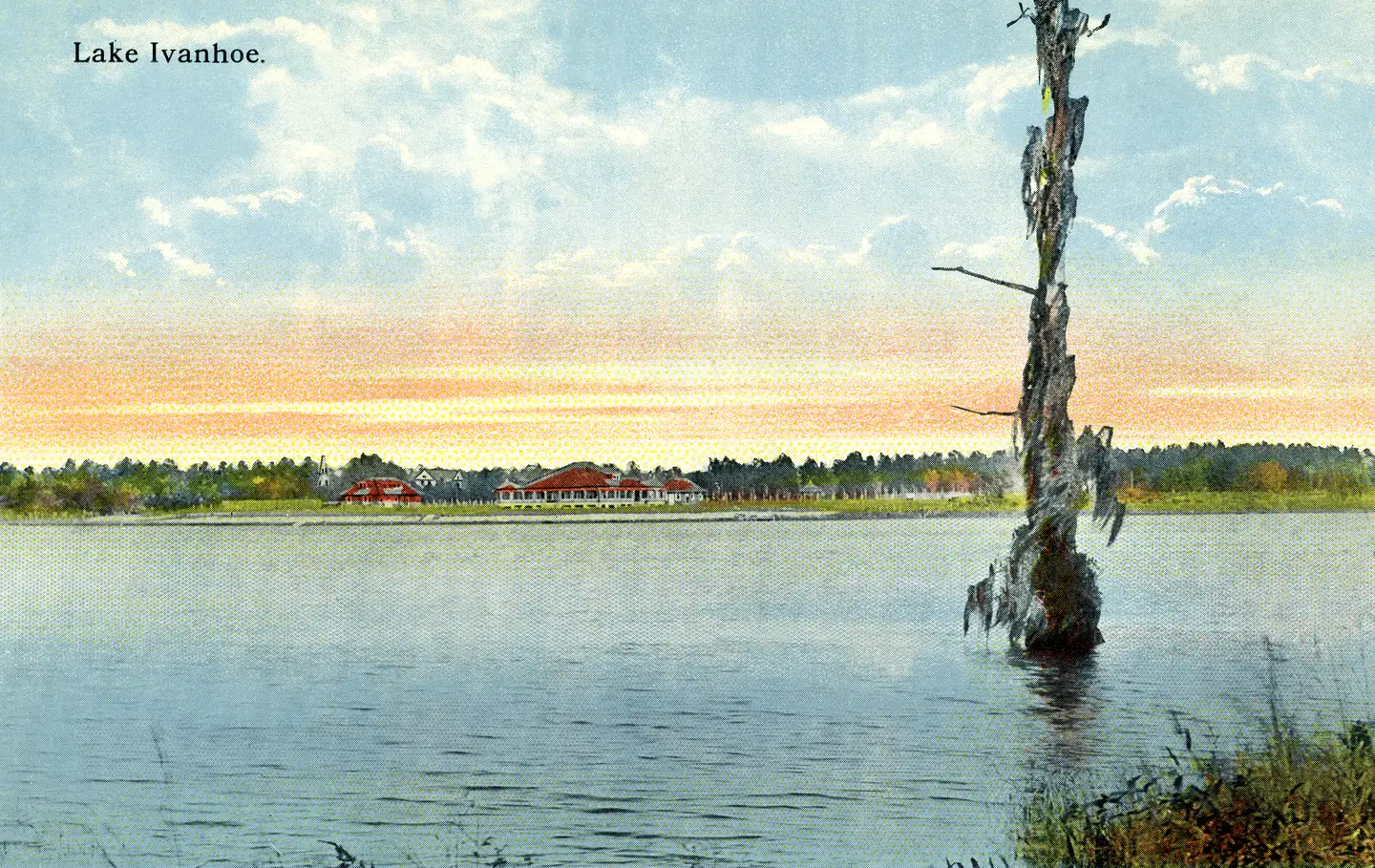
Chapter One · 1849 to 1885
A Grist Mill, a Cotton Field and a Quiet Shore
The Ivanhoe shore was settled long before it was a commercial district. D.K. Hall, previously a soldier at Fort Gatlin, acquired property in the area in 1849 and ran a grist mill on a stream between lakes Ivanhoe and Formosa. In 1854, James Gamble Speer bought acreage on the shore of Lake Ivanhoe and planted it in cotton.
The Civil War wiped out the cotton industry, and after the war settlers came in on federal land grants through the 1862 Homestead Act. The shore stayed farms, groves and woods, with scattered houses, while the lakes around it waited for a city to grow up to them. The residential Ivanhoe area sits among three of them, Lake Ivanhoe, Lake Adair and Lake Concord, and as early as 1883 the chain of lakes here was being spoken of as a potential waterway that could give small steamboats a route from Lake Jesup.
By the 1880s the railroad and publicity about citrus growing attracted a new wave of settlers to Orlando, and the wave reached this shore too. What they found was water, grove land and a lake with a brand new literary name, which is the next chapter of the story.
Then and Now
The mill stream and the cotton field are long gone, but the lake still runs the district. The guide's Ivanhoe Village day starts the way the settlement did, at the water: brunch at White Wolf Cafe, a slow walk to glassy water, a clear kayak on Lake Ivanhoe.
Chapter Two · 1819 to 1884
One Lake Is Literature, the Next Is a Love Letter
Lake Ivanhoe was named by a landowner for a book. A National Park Service nomination states that F.N. Abbott gave Lake Ivanhoe its name because he was a fan of the classic novel written by Sir Walter Scott in 1819. A College Park tour history gives a date and a slight disagreement: N.F. Abbott, spelled that way in that document, bought 40 acres on the lake in 1880 and christened it Ivanhoe, perhaps after Scott's novel.
The initial order differs between the two sources, F.N. in the Park Service nomination and N.F. in the 1992 tour document, but both agree on Abbott, on Scott, and on the naming, so this page prints both sets of initials and lets the disagreement stand. The 407 FYI Flashbacks card tells the short version: Abbott named the lake for the Saxon knight of the novel, and around the same time his neighbor was naming the next lake over.
Next door, Lake Adair reportedly got its name in 1884, when John W. Childress bought an adjacent grove and bestowed his wife's name on the lake. The Park Service nomination says the same in shorter form, that Childress named Lake Adair for his wife. The word reportedly belongs to the source, Orlando Memory, and it stays in the sentence here.
Then and Now
The names are still on the map and on the pavement. Ivanhoe Boulevard and Lake Adair Boulevard carry the novel and the marriage onto the street signs, and the district itself eventually took its name from the lake. Two lakes, one medieval novel, one marriage.
Chapter Three · 1885 to 1919
Pineapples, Then a Park With Fifty Boats
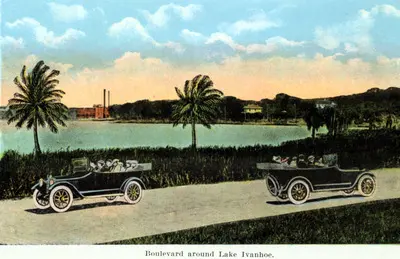
George I. Russell came to Orlando in 1885 from Connecticut, opened a downtown business selling hay, feed, fertilizer and grain, and bought a large parcel on the southern side of Lake Ivanhoe, becoming a large landholder on the lake's south and west shores. The shore had its businessman, and he had plans for the ground between the lakes.
First came the pinery. Russell developed acreage between Lake Concord and Lake Ivanhoe into a pineapple plantation, and the venture grew large enough that in 1900 The Florida Agriculturist proclaimed Orlando as the mother of the pineapple business. The lake that a novel named had become, for a while, the center of a fruit industry.
Then, in 1910, he built Russell's Point, also called Ivanhoe Park, described by historian Eve Bacon as an amusement and recreation park on Lake Ivanhoe with a dock, water slides, a dance hall, a picnic area and 50 boats. The park was later called Joyland. Russell closed it and sold his 30 acres in 1919, to be developed into the subdivision from which College Park would emerge. The amusement park became house lots, and the shore changed jobs again.
Then and Now
Russell's park is gone, but its name is pouring. Ivanhoe Park Brewing Company is in the guide today, and the guide says its name honors Lake Ivanhoe founder George Russell and old Joyland amusement park. The pint is the memorial.
Chapter Four · The Working Corridor
Mules Up Orange Avenue
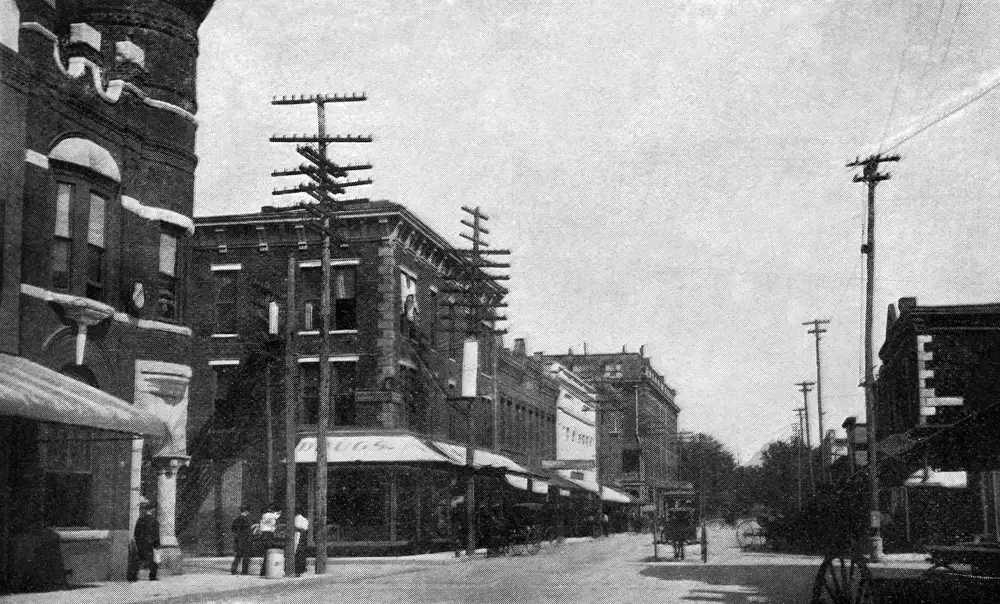
Transit found the lake early. The Orlando Street Railway Company was established six years after the railroad was completed in 1880, tracks were laid down Church Street and along Orange Avenue, and a trolley pulled by two mules carried Orlandoans up to Lake Ivanhoe. The ride tied the little downtown to the lake shore years before the shore had a district name.
It did not last. The city revoked that company's franchise in 1893 and later ordered the tracks removed. A second line outlived it by generations: the Orlando and Winter Park Railroad, begun in 1889 and nicknamed the Dinky Line, ran from downtown Orlando winding by Lake Highland and Lake Formosa up to Rollins College, ran for over 70 years, and made its last run in 1967.
Then and Now
The mules and the Dinky Line are gone, but the route is still the district's spine. Orange Avenue still carries you from downtown to the lake, and the guide still walks you up it, past the vintage racks of the Ivanhoe Village list.
Chapter Five · 1921 to 1956
The Boom Drew the Neighborhood
The modern residential pattern dates to the Florida Land Boom. The Lake Ivanhoe Residential Historic District comprises parts of subdivisions platted by Walter Rose starting in 1921, and in 1925 the Cooper-Atha-Barr Company added more college named streets in the first of nine subdivisions to be named College Park. The district was listed on the National Register of Historic Places in 2010, covers 262 acres, and its buildings date from the Florida Land Boom of the 1920s through the postwar 1950s.
Next door, the Lake Formosa area shows the same boom in miniature. It was first settled in 1880 by Philadelphia attorney James M. Wilcox, the South Florida Railroad came in 1881, and in 1887 the Village of Willcox was renamed Formosa. The first subdivision there was Idlewild Park in 1911, north of Virginia Drive. In 1925 the Town of Formosa was annexed by Orlando and Loch Haven Grove came under the City parks department, and Loch Haven Grove would later become a master planned Science and Arts Center in 1956.
Virginia Drive was the early commercial strip. In 1924 there were two grocery stores on Virginia Drive, Barfield's near Lake Ivanhoe and Cottage Grocery near Mills, and in 1926 Virginia Drive became the first street in the Lake Formosa neighborhood to be paved with bricks and get streetlights.
Loch Haven Park became the cultural cluster inside the district, home to the Orlando Museum of Art, founded in 1924, the Orlando Science Center, Orlando Shakes, and the Mennello Museum of American Art, founded in 1998 by the City of Orlando and housed in what was once the private home of Howard Phillips.
Then and Now
The boom era plan is still the working plan. Loch Haven Cultural Park is officially part of Ivanhoe Village today, and the guide's own list keeps a seat in it: Orlando Science Center & The Dome, holding the park's science and arts brief where the 1956 master plan put it.
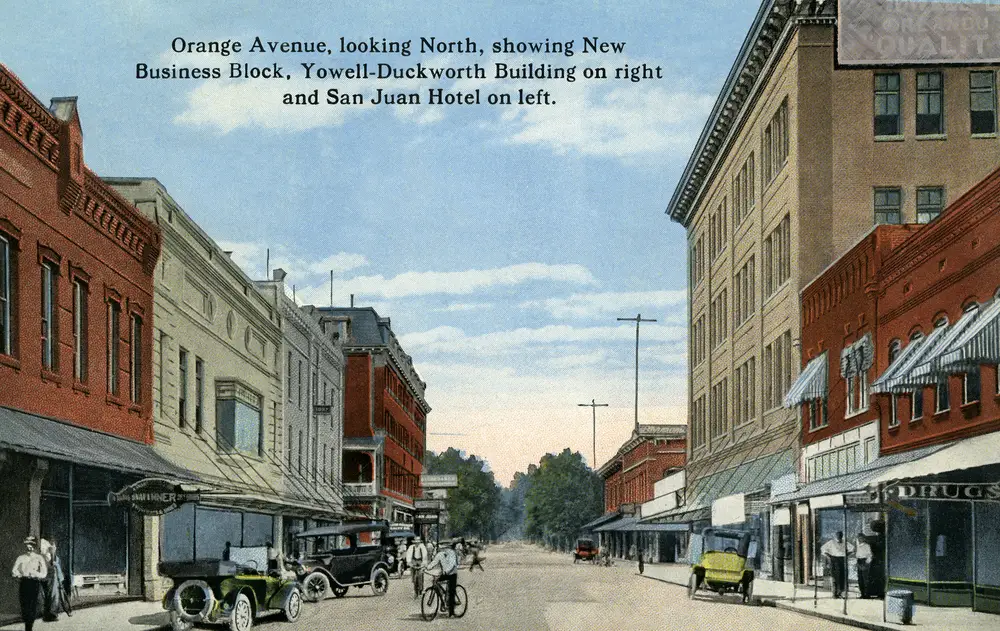
Orange Avenue in its business district days, on a Curt Teich postcard dated 1915. ClipPix ETC, University of South Florida. Public domain.
Chapter Six · Antique Row to Main Street
Antique Row Learns a New Name
The North Orange Avenue strip developed an identity of its own, and it was not the one on the signs now. For years Ivanhoe Village Main Street's primary lakefront shopping district was locally known as Antique Row, and Orlando Magazine likewise calls Ivanhoe Village formerly Orlando's historic Antique Row, a walkable district home to dining, shops and nightlife.
The Village name is younger than the lake name by more than a century. Ivanhoe Village is the Main Street era brand built on the lake's name, documented in City of Orlando Main Street materials after the Orlando Main Streets program was created in 2008. No source consulted shows Ivanhoe Village in use as a district name before the Main Street era, while Antique Row is documented as the older local name for the strip.
City annual reports describe the modern district as reinventing itself to include Ivanhoe Row, Virginia Drive, Loch Haven Cultural Park and Florida Hospital Health Village, with small scale one and two story storefront buildings facing the street and many displaying Art Deco characteristics.
Then and Now
Antique Row's trade never really left. The guide still sends you to vintage racks up Orange Avenue, and the small storefronts the city reports described now hold the cafes and bars of the Ivanhoe Village list, from White Wolf Cafe to The Lucky Lure.
The Index in the Street Signs
How the Streets Got Their Names
A district named from a book confesses the rest of its story in its street signs. Ivanhoe's name the lake and the novel, the grove the great avenue once ended at, a Chicago Avenue renamed in two acts, and a drive whose family story stays labeled lore.
- Ivanhoe Boulevard: named for Lake Ivanhoe, which Abbott named for Sir Walter Scott's 1819 novel. The boulevard takes the lake's literary name onto the pavement.
- Orange Avenue: the north end of the downtown avenue, with the same sourced account: it originally dead ended at an orange grove at the north end of town, in the citrus Golden Era of 1875 to 1895.
- Alden Road: the Alden namesake is undocumented, but the rename chain is on record. Alden was Chicago Avenue in the 1911 Idlewild Park plat, and a 2017 city ordinance changed Philadelphia Avenue and South Lake Formosa Drive segments to Alden Road to give the whole length a single name.
- Lake Adair Boulevard: named for Lake Adair, which John W. Childress reportedly named in 1884 for his wife after buying an adjacent grove.
- Virginia Drive: the family naming story told for the streets around Virginia Drive is local lore, labeled as such: no credible source consulted ties Virginia Drive to a specific person or a developer's family member. The street's documented history is commercial, two grocery stores in 1924 and brick paving with streetlights in 1926.
New Hampshire Street, Dauphin Lane and Highland Avenue have no published etymologies in the sources consulted, and Lake Concord's own naming origin was not found either, though the lake anchors a historic district dedicated in 2023. Dauphin is at least documented early: the owners of Barfield's grocery on Virginia Drive in 1924 lived on it.
Then and Now
Read the signs on a single walk and you have read the district: Ivanhoe Boulevard for the novel, Lake Adair Boulevard for the marriage, Alden Road for a plat drawn in 1911, and Virginia Drive for the brick paved strip where the groceries stood in 1924.
The Story, On Foot
Walk It Today
Walk it the way the guide runs it, lake first. Brunch at White Wolf Cafe, a slow walk to glassy water, a clear kayak on Lake Ivanhoe, the lake Abbott named for a knight and Russell planted and played beside. Then up Orange Avenue, the old trolley route, through the vintage racks and studio doors of the strip that answered to Antique Row for years.
Give Loch Haven its hour: Orlando Science Center & The Dome keeps the cultural cluster working inside the district. As the sky goes lavender, tapas at Santiago's Bodega, and finish with a pint at Ivanhoe Park Brewing Company, where the name on the door still honors the man who built the first park on this shore. Nothing on the route is a reconstruction. It is the shore, still inhabited.
From the Flashbacks
More history
Images and sources
Every photograph on this page is in the public domain. Follow any credit to its archive record.
- Lake Ivanhoe, dated 1915: postcard by Curt Teich & Co. in the Orlando, Fla. souvenir folder, via ClipPix ETC, University of South Florida. Public domain, published 1915.
- Boulevard around Lake Ivanhoe postcard: Hampton Dunn Collection of Florida Postcards, University of South Florida. Rights statement on the record: No Copyright, United States. Public domain.
- The business section on Orange Avenue, dated 1910: postcard by the Douglas Publishing Co., via ClipPix ETC, University of South Florida. Public domain, published about 1910.
- A view of Orange Avenue, dated 1915: postcard by Curt Teich & Co. in the Orlando, Fla. souvenir folder, via ClipPix ETC, University of South Florida. Public domain, published 1915.
Story sources: the National Park Service National Register nomination, Orlando Memory, the College Park Historic Homes Tour history and the 407 FYI Flashbacks. The sourced district history, street by street, lives on the District Histories page.