Chapter One · 1937
A Plat Called Lakewood Estates
Audubon Park starts on paper, and the paper says a different name. Neighborhood histories date the plat of the neighborhood to 1937, under the name Lakewood Estates, with streets named after birds. It was a modest beginning for a district that would spend the next decades in the orbit of two military bases, and the bird streets drawn into that first plat are still the fastest way to understand the map.
Growth came with the war years. The same histories say growth accelerated in the 1940s and 1950s to house military families, and Main Street America describes Audubon Park as developed post World War II, long defined by a wide, four lane commercial main drag dotted with suburban strip malls. The plat supplied the grid and the birds. The bases supplied the people.
Then and Now
That wide commercial main drag is Corrine Drive, and its anchor today is East End Market, the food hall the guide sends you to first. The strip mall corridor the postwar plat produced is the same corridor you eat along now.
Chapter Two · The Name
A Name Lost to Time
Here is the honest version, because this district deserves it told straight. Visitor material says the neighborhood honors its namesake, the National Audubon Society, and that its tree lined streets are named after birds. The bird streets are real, and you can read them off the signs today. The rest of that sentence is tradition, not record.
Orlando Magazine states the documented version: Audubon Park was originally known as Lakewood Estates, the how and when of the transition have been lost to time, and the official history attributes the change to the naming of several streets for birds, similar to the way nearby College Park reflects its streets named for institutions of higher learning. No source consulted documents a developer choosing the Audubon name, a request to the Society, or permission from it. So the National Audubon Society story is told on this page as the tradition it is, not as the record it is not.
The 407 FYI Flashbacks card for the district ends with the practical advice: look out the window instead of at your phone, because the street signs are a bird guide. Whatever committee, clerk or custom carried the name from Lakewood Estates to Audubon Park left no paper behind. The birds left theirs on every corner.
Then and Now
The bird grid still does the naming work in person. You can stand on Corrine Drive at a guide table, at Coro, and navigate home by Falcon, Cardinal and Dove. The tradition is unverified. The signs are not.
Chapter Three · The Military Decades
Built for the Bases
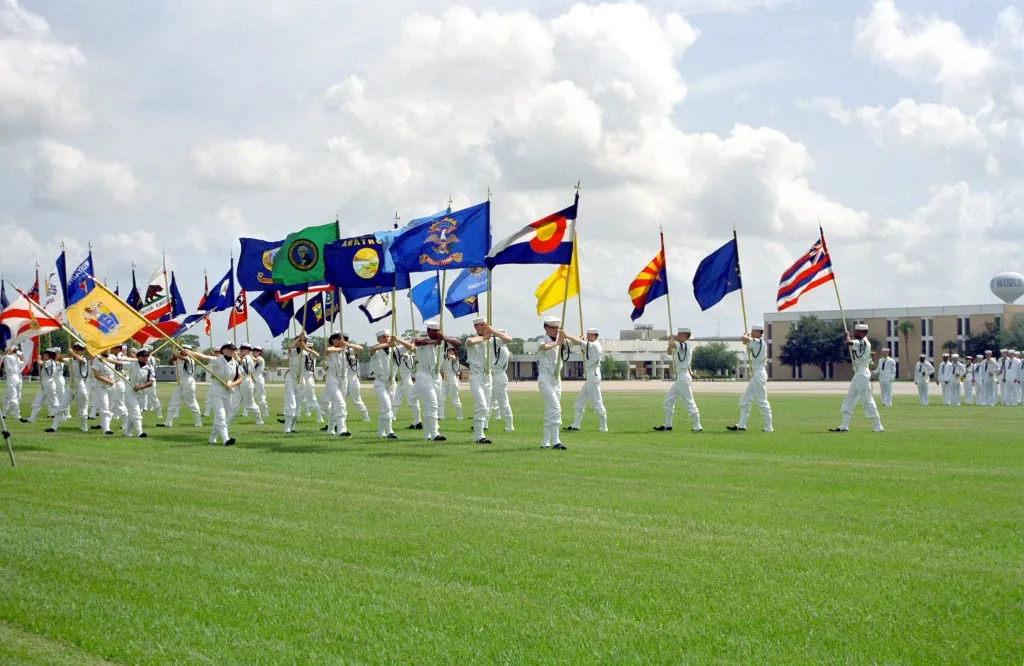
The military connection is the district's defining era. Beginning in World War II and through most of the Cold War, Orlando was home to two high profile military installations, Naval Training Center Orlando and McCoy Air Force Base. McCoy was the region's largest employer before Walt Disney World opened in 1971. Until the Naval Training Center's decommissioning in 1999, these bases brought countless service people and their families to the area, many of whom built homes in Audubon Park.
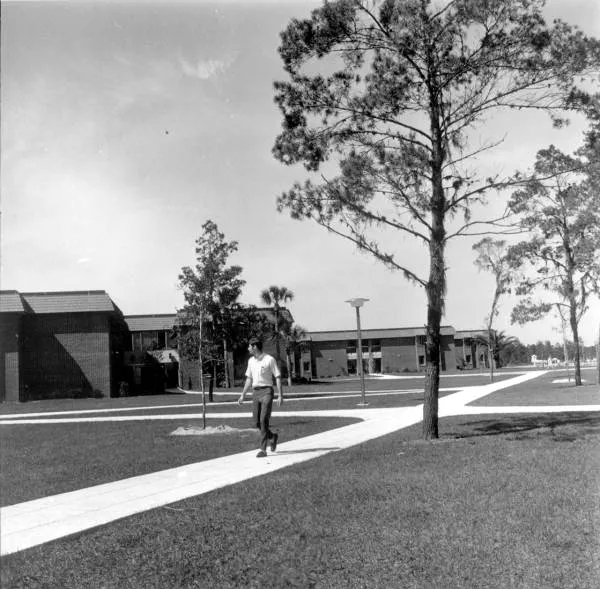
The houses tell that story in building materials. Orlando Magazine gives the housing stock a 1950s character, describing cinderblock and terrazzo homes and the area's history as off base housing for the former Orlando Naval Training Center. McCoy Air Force Base itself was in use from 1940 to 1975, and its site is now Orlando International Airport, which keeps the MCO code from McCoy.
Even the main street is a military artifact. Corrine Drive was originally constructed to service heavy equipment on the way to the Naval Training Center from 17-92, and it was built before the area was even part of Orlando, according to the city, as reported by Bungalower. The road that now carries the district's restaurants was graded for base traffic first.
Then and Now
McCoy survives as three letters on every luggage tag at Orlando International Airport: MCO. Closer to home, the off base blocks are the neighborhood itself, and Corrine Drive's guide names, Kelly's Homemade Ice Cream and Sushi Lola's among them, sit on the old heavy equipment route.
Chapter Four · 1936 to 1961
The Garden on the Eastern Edge
While the bases were building the district's west side, its eastern edge was becoming a garden. Harry P. Leu Gardens sits at 1920 North Forest Avenue on the eastern edge of Audubon Park, at 50 acres. Harry P. and Mary Jane Leu purchased the property in 1936 and traveled extensively, bringing back plants and seeds from their trips.
In 1961, the house and gardens were part of the Leu gift to the City of Orlando. A private estate assembled plant by plant became public ground, and it stayed the district's green anchor through everything that followed: the base years, the base closure, and the rebranding that would eventually take its cue, and its name, from the garden.
Then and Now
The gift still holds the eastern edge. The guide pairs a Corrine Drive morning with a soft light loop through Leu Gardens, the same ground the Leus deeded to the city in 1961.
Chapter Five · 1999 to 2016
After the Base, the Garden District
The Naval Training Center closed in phases, and all remaining operations ceased on April 30, 1999. A neighborhood built to house a base could have faded with it. Audubon Park rebranded instead. The community remade itself as the Audubon Park Garden District, in honor of Harry P. Leu Gardens, and the Garden District Main Street program dates to 2008.
The proof of the rebrand is a church that became a food hall. East End Market, the district's food hub, opened on November 1, 2013 in a former church building, and Main Street America credits the district with transforming a foreclosed church into a nationally recognized food and culture hub. In 2016, the district won the Great American Main Street Award. Two years earlier, in 2014, Audubon Park had become the first neighborhood in Central Florida recognized as a Wildlife Habitat Community, certified through the National Wildlife Federation. The garden district name, it turned out, was also a description.
Then and Now
East End Market is still the district's front room, and the guide's names inside it are the rebrand at work: Domu, Hinckley's Fancy Meats, Lineage Coffee Roasting and Winter Park Biscuit Company, all under the old church roof on Corrine Drive.
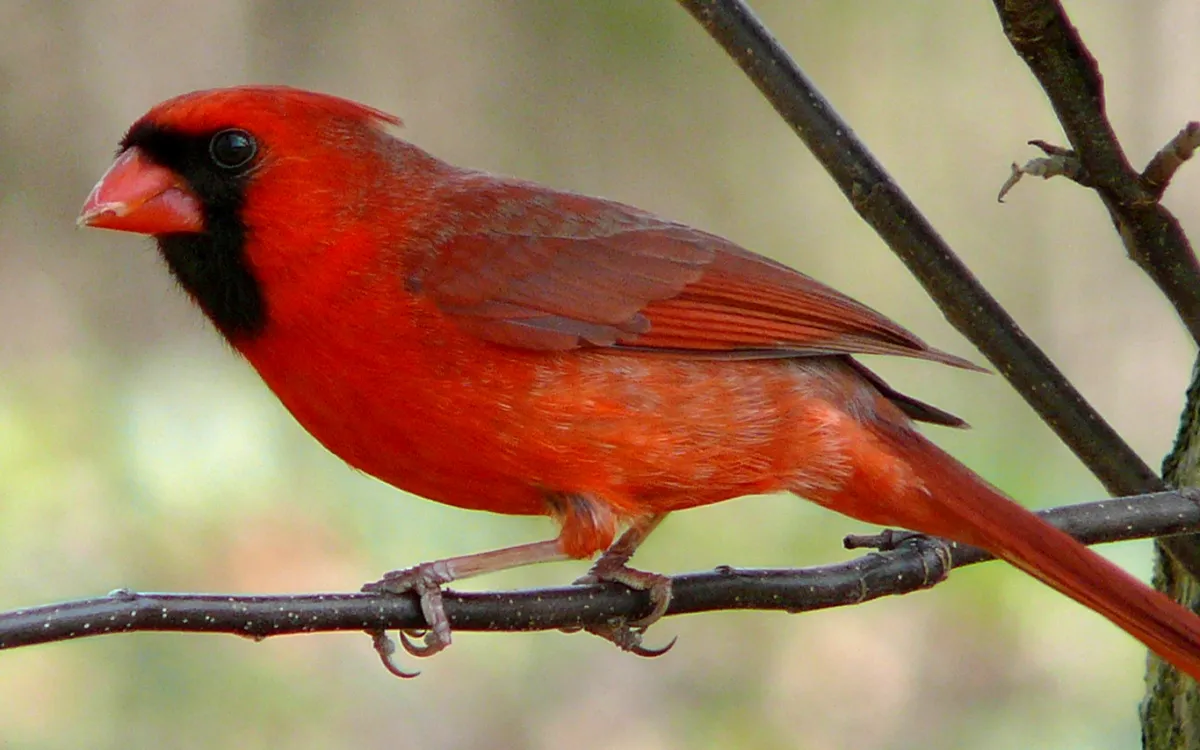
A northern cardinal, the bird on Cardinal Road. Photograph by Ken Thomas, public domain, via Wikimedia Commons.
The Index in the Street Signs
How the Streets Got Their Names
Audubon Park's street signs are a field guide with one honest exception. The birds are documented, street by street. The main street's namesake is not, and this panel keeps both facts in the same place.
- Falcon Drive: the falcon. The neighborhood school sits at 1500 Falcon Drive.
- Cardinal Road: the cardinal.
- Dove Drive: the dove.
- Robin Road: the robin.
- Ibis Drive: the ibis.
- Pelican Lane: the pelican.
- Tanager Drive: the tanager.
- Finch Street: the finch.
- Osprey Avenue: the osprey.
- Bobolink Lane: the bobolink.
- Wren Lane: the wren.
- Mockingbird Lane: the mockingbird.
- Oriole Avenue: the oriole.
- Raven Road: the raven.
- Heron Drive: the heron.
- Lark Place: the lark.
- Teal Road: the teal, a duck.
- Bluebird Place: the bluebird.
- Corrine Drive: the district's main street, and the exception in this panel: who Corrine was is undocumented, and no source consulted identifies a person behind the name. The road's own origin is documented instead. It was originally constructed to service heavy equipment on the way to the Naval Training Center from 17-92, built before the area was even part of Orlando.
The undocumented names stay undocumented here. No person named Corrine has ever been sourced behind Corrine Drive. The district name itself, Audubon Park, rests on tradition rather than a naming record, as the name chapter above lays out. Four bird names often assumed to be here are not evidenced: Egret, Plover, Bobwhite and Scarlet do not appear in the neighborhood street list consulted, which lists Bobolink Lane where a Bobwhite might be expected. Winter Park Road's geographic reading, the road toward Winter Park, is likewise not presented as documented fact. And Banchory Road, sometimes filed under Audubon Park, is a Winter Park street.
The Story, On Foot
Walk It Today
Walk the military main street first, because that is what Corrine Drive still is, under newer signs. Start at East End Market and work the corridor the guide walks: Coro and Foreigner Restaurant for dinner, Sushi Lola's and Kelly's Homemade Ice Cream along the drive, and inside the market, Domu, Hinckley's Fancy Meats, Lineage Coffee Roasting and Winter Park Biscuit Company. Every address on the route sits a street or two from a bird.
Then walk the birds themselves, Falcon to Cardinal to Dove, out to the Audubon Park Community Market on East Winter Park Road, and finish at the district's eastern edge in Leu Gardens, on the ground the Leus bought in 1936 and gave to the city in 1961. Plat, bases, garden: the whole story is one slow loop, and the street signs narrate it if you read them like a field guide.
From the Flashbacks
More history
Images and sources
Every photograph on this page is in the public domain. Follow any credit to its archive record.
- Graduation drill team with state flags at Naval Training Center Orlando, July 24, 1992: Combined Military Service Digital Photographic Files, National Archives at College Park, U.S. Department of Defense, via RICHES of Central Florida. Public domain.
- The barracks at Naval Training Center Orlando, March 1970, photograph by Johnson: State Archives of Florida, Florida Memory, Department of Commerce Collection, Florida Photographic Collection. Public domain.
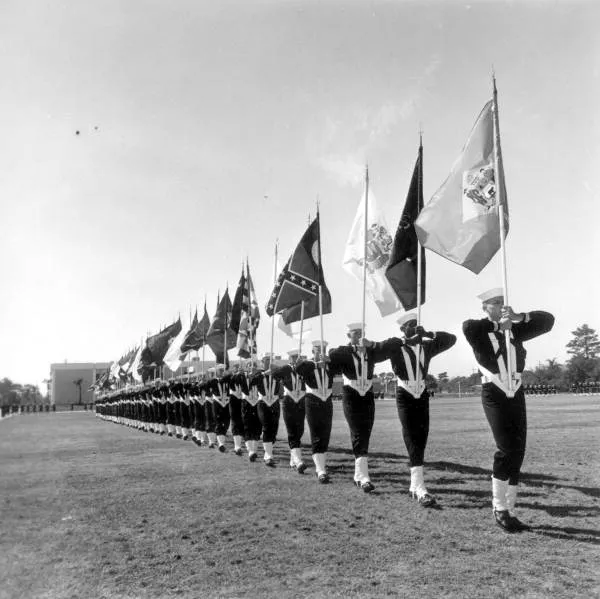
- Flag corps at Naval Training Center Orlando, March 1970, photograph by Johnson: State Archives of Florida, Florida Photographic Collection, via RICHES of Central Florida. Public domain.
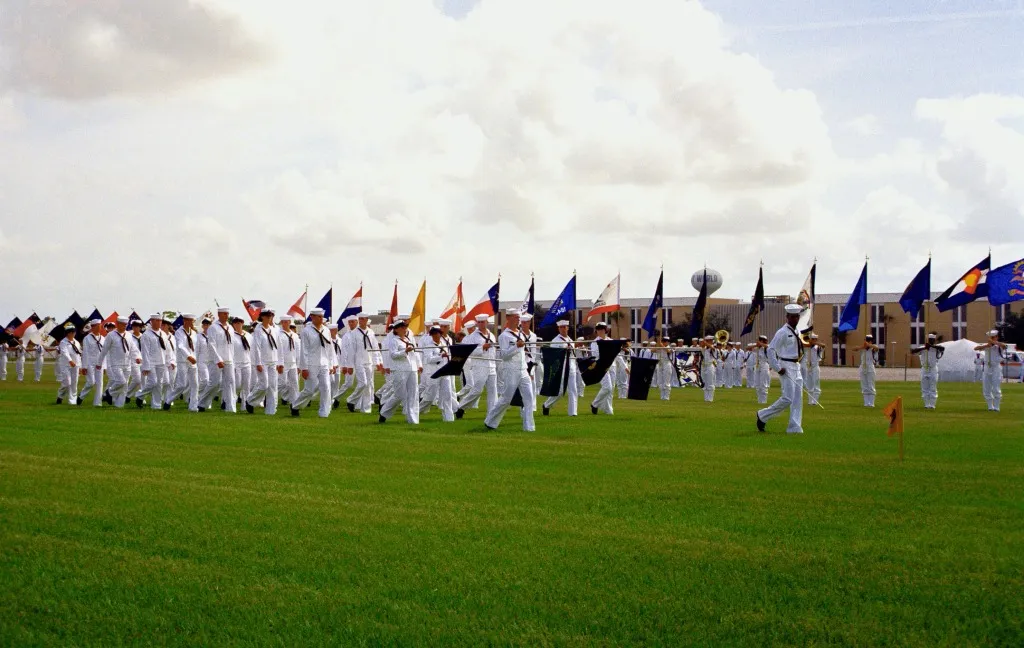
- Recruits passing in review at Naval Training Center Orlando, July 24, 1992: Combined Military Service Digital Photographic Files, National Archives at College Park, U.S. Department of Defense, via RICHES of Central Florida. Public domain.
- Northern cardinal, photograph by Ken Thomas: Wikimedia Commons. Public domain.
Story sources: Orlando Magazine, Visit Orlando, Main Street America, the Audubon Park Garden District, Leu Gardens and the 407 FYI Flashbacks. The sourced district history, street by street, lives on the District Histories page.